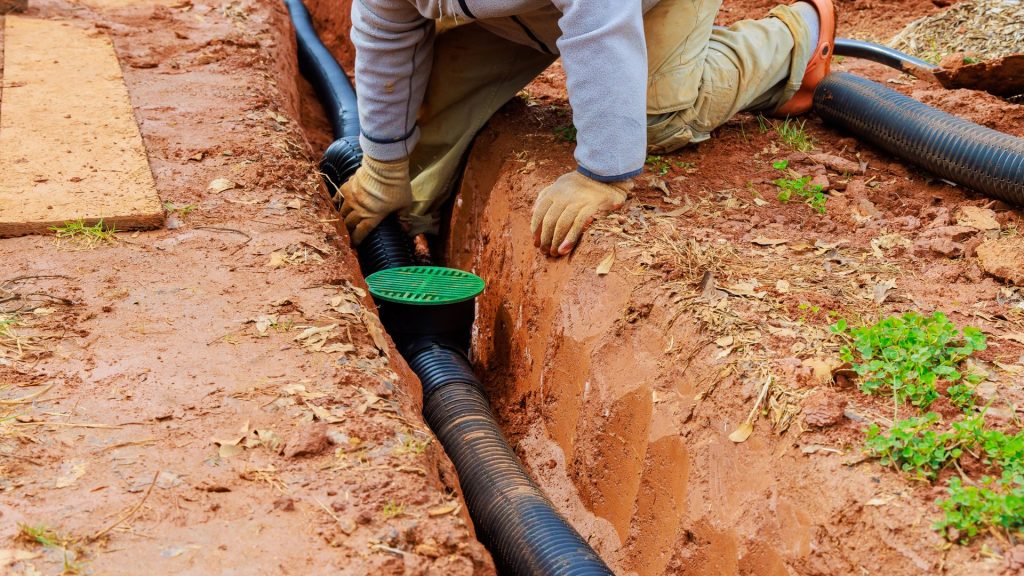
A French drain is a subsurface collection system, not merely a perforated pipe buried in gravel. Its purpose is to create a path of lower resistance for water moving through saturated soil, then convey that water toward a safe outlet. Performance depends on where the trench intersects the wet zone, whether the route has continuous fall, how water enters the aggregate, how the pipe is configured, and whether the outlet can remain open. A well-built trench in the wrong location can still leave the original problem untouched.
A search for drain service near me may produce many installation options, but proposals should be compared by design logic rather than trench length alone. The contractor should explain the source being intercepted, the elevations used, the chosen pipe and aggregate, the fabric placement, cleanout access, outlet protection, and restoration. An emergency drain service may be justified when runoff is actively threatening access or property, yet permanent work still requires utility locating, site assessment, and a route that does not transfer damage elsewhere.
French drains are most effective when subsurface water is the actual problem. They may be combined with surface grading, downspout conveyance, catch basins, swales, or erosion control, but those features perform different jobs. Mixing roof water directly into a perforated collection line can overwhelm the trench or release water along its length if the design is not deliberate. Understanding each component helps homeowners recognize why apparently similar estimates can describe systems with very different durability and capacity.
Place the Trench Where It Can Intercept Water
The trench should cross the direction of subsurface flow or run along the edge of the area that needs protection. Installing it through the center of the lowest puddle may collect water after saturation has already spread, while an uphill interceptor can reduce the amount reaching that location. The proper position depends on topography, soil layers, structures, property boundaries, roots, utilities, and outlet elevation. Test observations during rain are often more informative than a dry-weather view.
Depth should relate to the water-bearing layer and the feature being protected. A shallow trench may manage near-surface saturation in turf, while deeper water beside a retaining wall or foundation involves additional structural and waterproofing considerations. Excavation near footings, walls, slopes, mature trees, septic components, and utilities can create serious risks. A landscape drain is not a substitute for structural engineering, foundation waterproofing, or municipal stormwater work when those systems are involved.
Route the trench so it can be installed and maintained with the least necessary disturbance. Straight runs simplify grade and cleaning, but site constraints may require changes in direction. Fittings should support flow rather than create abrupt restrictions. Cleanouts or access points are especially useful at long runs and direction changes. The design should note where machines can travel, where spoil will be placed, and how lawn, beds, irrigation, lighting, and hardscape will be restored.
Use Elevation to Create a Reliable Gravity Path
Gravity drainage needs a continuous downhill route from the collection zone to the outlet. Laser levels or other surveying tools provide evidence that visual judgment cannot. The bottom of a trench may rise even when the ground surface falls, especially across filled areas or rolling lots. Pipe sags collect sediment and water, while a high point can stop low flows entirely. Elevations should be checked during excavation and again before the system is covered.
A steeper pipe is not always possible or necessary, but insufficient fall leaves little tolerance for settlement or installation error. The designer should account for inlet depth, aggregate, pipe diameter, fittings, outlet elevation, and cover needed to protect the system. If gravity cannot reach a suitable outlet, a pump basin may be considered. Pumps require electrical planning, alarms, check valves, freeze protection, service access, and a discharge route capable of handling the flow when power is available.
The outlet controls the entire system. A buried pipe that ends in a flat wet area cannot move water reliably just because the upstream trench is deep. Daylight outlets need stabilization against erosion and protection from animals, leaves, mowing equipment, and crushing. Connections to storm infrastructure require approval. Discharge should not create ice, wash out a slope, undermine pavement, or cross neighboring property. Residual water and overflow behavior should be discussed before construction.
Choose Pipe and Aggregate for the Intended Function
Perforated pipe accepts water along the trench, while solid pipe transports collected water without intentionally releasing or accepting flow. A system may use both: perforated pipe through the interception zone and solid pipe to the outlet. Pipe stiffness, interior smoothness, perforation pattern, fittings, burial depth, loading, and cleanability affect the choice. Flexible corrugated tubing can follow uneven trenches but may be more vulnerable to sags or crushing if installation and cover are unsuitable.
Washed, durable aggregate creates void space around the pipe and gives water a route through the trench. Fine material mixed into stone can reduce those openings. Angular and rounded aggregates behave differently during placement and loading, so local design and material specifications matter. Decorative stone at the surface may serve a visual or inlet function, but the visible layer does not reveal whether the below-grade aggregate is clean, deep enough, or continuous.
The USDA Natural Resources Conservation Service offers urban soil drainage guidance explaining how compaction, infiltration, grading, and soil properties affect developed landscapes. These conditions influence how quickly water reaches a French drain and whether infiltration is appropriate near a structure. No aggregate can make impermeable surrounding soil absorb water rapidly. The drain’s job is often conveyance, so its connection to a dependable outlet matters as much as the trench’s storage volume.
Use Filter Fabric as Part of a Complete Soil Strategy
Filter fabric is intended to limit migration of surrounding soil into aggregate while allowing water to pass. Its type, placement, overlap, and compatibility with local soil affect performance. Wrapping only the pipe leaves the larger stone voids exposed to sediment. Lining a trench carelessly can create folds, gaps, or a closed top that changes how surface water enters. The design should state whether the drain is intended to collect subsurface flow only or also accept controlled surface infiltration.
Fabric can clog when fine sediment is continually delivered from eroding slopes or bare soil. The upstream erosion source should be stabilized rather than expecting the trench to filter unlimited sediment. Construction traffic, excavated clay, and muddy runoff can contaminate aggregate before the project is finished. Keep clean stone separated from spoil and protect open trenches from storm inflow. If topsoil and turf will cover the system, preserve enough soil for roots without sealing the intended water-entry zone.
Tree roots respond to moisture and available pore space. Fabric is not a permanent root barrier, and every pipe joint or opening can become an opportunity over time. Route drains thoughtfully around valuable trees and avoid severing major roots without arboricultural guidance. Where root intrusion risk is high, accessible cleanouts and suitable pipe construction become more important. Planting plans should account for the final trench location rather than placing moisture-seeking species directly over critical access points.
Integrate Surface Water Without Overloading the Trench
A French drain can intercept water within soil, but fast surface runoff may cross the trench before soaking into the aggregate. Shallow grading, swales, channel drains, or catch basins can collect that flow more directly. Inlets should be placed where water naturally concentrates and shaped so surrounding grades lead into them. Grates need openings appropriate to expected debris and safe for walking, pets, and maintenance equipment. A clogged surface inlet can make the buried system appear undersized.
Downspouts often carry short bursts of high flow. Routing them through solid pipe can keep roof water separate until it reaches the main outlet or another approved feature. Connecting a downspout directly to perforated pipe may introduce water into already saturated soil if capacity is exceeded. The designer should calculate or at least reasonably evaluate contributing roof area, rainfall intensity, pipe capacity, and overflow. An above-grade emergency spill path prevents a blocked underground line from forcing water against the building.
Hardscape edges require care because excavation can undermine bases or create settlement. A trench beside a driveway, patio, or wall should preserve structural support and manage water that enters joints. Restored soil must be compacted appropriately without crushing the pipe or eliminating the drainage path. Surface grades after restoration should continue moving water toward collection points rather than creating a new depression over the trench.
Inspect Installation and Plan Long-Term Access
Before burial, verify trench location, depth, continuous fall, pipe transitions, perforation orientation according to the design, aggregate cleanliness, fabric placement, cleanouts, and outlet elevation. Photograph the entire route with measurements from fixed landmarks. Confirm that utility markings remain respected and that unexpected pipes or cables are resolved rather than worked around without documentation. Any field change should be added to the as-built sketch.
Controlled water testing can reveal obvious restrictions and outlet problems, although it may not reproduce a saturated-soil event. Observe the system during natural rainfall after restoration and compare the wet area, discharge timing, and downstream effects with the original condition. Settlement, muddy discharge, erosion, or water surfacing along the trench can indicate a correction is needed. Performance should be evaluated across more than one storm because intensity and antecedent soil moisture vary.
Keep inlets, cleanouts, and outlets visible and accessible. Remove leaves, sediment, turf, and animal nests before they block flow. Do not drive heavy equipment over shallow lines unless they were designed for that load. Update records after landscaping, fences, irrigation, or hardscape changes. French drains can function for many years when their source, route, and outlet remain intact, but no buried system is maintenance-free.
Conclusion
French-drain performance depends on intercepting the correct water, maintaining continuous fall, using suitable materials, protecting the trench from sediment, and preserving a safe outlet. Those details explain why two systems with similar visible stone can behave very differently. Huntsville-area homeowners can reference Cora Landscape when evaluating French-drain installation, yard saturation, outlet planning, erosion control, and restoration needs.