Immune checkpoint inhibitors have transformed many cancer therapies by releasing the brakes on the immune system; however, this has produced several limitations such as primary resistance, immune-related adverse events (irAEs), and the inability to treat non-responsive tumor types. Therefore, novel immune checkpoint inhibitors target other co-inhibitory and co-stimulatory pathways.
Next generation immune checkpoint inhibitors target emerging receptor pathways, including LAG-3, TIGIT, TIM-3, VISTA, and OX40, as well as bispecific formats targeting two checkpoint mechanisms.
Understanding the Mechanism of Next-Gen Pathway Modulation
First generation therapies are designed to interrupt PD-1/PD-L1 and CTLA-4 pathways. Next generation therapies will target other T and NK cell exhaustion pathways.
Overcoming the consequences of the redundant immunosuppressive pathways will be a major challenge. Tumor microenvironments often upregulate secondary checkpoints in response to blocking of primary checkpoints.
New blockade pathways designed to reverse T cell exhaustion will be combined to make previously unresponsive, “cold”, tumors “hot” to immunotherapy and to other treatment modalities.
Why the Medical Community Is Paying Attention
Next-generation checkpoint inhibitors offer opportunity to treat patients that have not responded to first-generation PD-1/PD-L1 agents. Other alternatives to monotherapies, including bispecific antibodies, allow for engagement of two immune checkpoints or a combination of a checkpoint with a tumor antigen.
Improved durable responses with reduced auto-immune toxicities have been observed with combinations of novel checkpoint inhibitors with anti-PD-1 agents.
Research has focused on identifying predictive biomarkers. Additionally, research has leveraged spatial transcriptomics and immunoprofiling to classify subpopulations of patients that may benefit from multi-pathway blockade.
Market Growth Reflects Rising Confidence
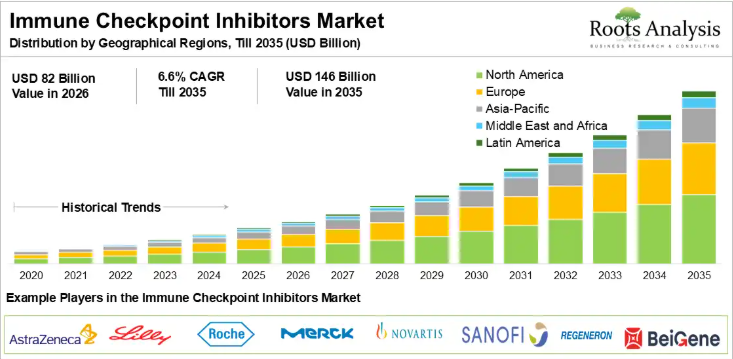
Industry projections from market research firm Roots Analysis clearly highlight the momentum behind this technology. According to their market report, the global immune checkpoint inhibitors market reached USD 75.0 billion in 2025 and grew to USD 82.0 billion in 2026. Roots Analysis projects the sector will reach USD 146.0 billion by 2035, expanding at a CAGR of 6.6%. Their insights reflect rising confidence as biopharma pipelines advance novel LAG-3, TIGIT, and bispecific checkpoint molecules into pivotal clinical trials.
Challenges Facing Adoption
- Balancing combination efficacy with potential cumulative immune-related adverse events (irAEs).
- Identifying reliable, standardized predictive biomarkers for patient stratification across diverse indications.
- Managing complex clinical trial designs required to evaluate multi-target combination therapies.
Conclusion
Next-generation immune checkpoint inhibitors will be important components of future cancer immunotherapies. We are in the initial stages of a revolution in biologic and drug development with the potential to create new multi-specific antibodies to improve the immune response in patients.