Shimla and Manali will always have traffic queues on Mall Road and lines of cafes along the riverfront. But Himachal Pradesh is a far larger state than its two famous hill stations suggest. If you are willing to add a few extra hours of driving to your plan, the state opens up into quiet valleys, villages at the edge of the map, and forest hamlets where the loudest sound is still the river. Here are ten places that reward the traveller who goes looking for them.
1. Tirthan Valley
Tucked beside the Great Himalayan National Park near Gushaini, Tirthan Valley is named after the Tirthan River that runs through it in water so clear you can count the stones at the bottom. The valley floor is dotted with traditional wood-and-stone cottages, many of them family-run homestays where the owner will likely be your cook, guide, and fishing instructor all in one. Trout fishing is the valley’s quiet signature, and short forest trails lead off toward waterfalls and meadow clearings.
Best season: April to June for warm days and river activity, October to November for crisp air and golden forests.
How to reach: Drive from Delhi to Aut on the Chandigarh-Manali highway (roughly 12 hours), then take the turn toward Banjar and Gushaini, about 35 km further.
Who it suits: Couples on a slow trip, anglers, and anyone who wants a mountain holiday without a trek on the agenda.
2. Chitkul
The last inhabited village on the old Indo-Tibetan trade route, Chitkul sits at about 3,450 metres in the Baspa Valley of Kinnaur. A signboard at the edge of the village says it plainly: India’s last village. Traditional wooden houses with carved balconies line stone lanes, and the Baspa River runs cold and fast beside the fields. Because the village is so close to the border, the landscape has a stark, dramatic quality that feels very different from the forests lower down. Indian nationals only need a valid photo ID at the ITBP checkpoint beyond the village.
Best season: May to October. The village is cut off by snow in winter.
How to reach: Delhi to Shimla, then the long but spectacular NH-05 drive via Rampur and Karcham to Sangla, and a final 24 km to Chitkul. Count on two to three days of driving each way.
Who it suits: Road trippers, photographers, and travellers who collect places at the edge of the map. Many travellers who plan their route with organised himachal travel packages find Kinnaur’s long driving days easier to handle with a planned itinerary.
3. Kalpa
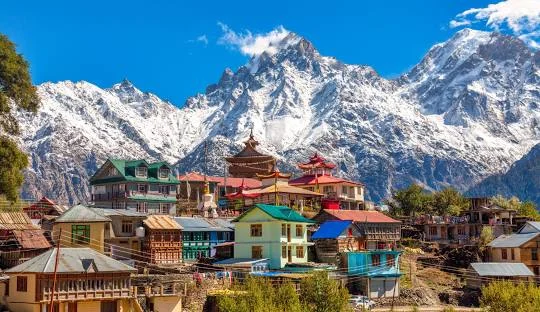
A few hours up the slope from Reckong Peo, Kalpa is the village from which the Kinner Kailash massif looks close enough to touch. At sunrise, the five-peaked rock face changes colour minute by minute, and on a clear day this is genuinely one of the finest mountain views in India. The village itself is calm, with apple orchards, a small monastery, and a centuries-old temple complex where Hindu and Buddhist architecture sit side by side.
Best season: April to June, and September to October for the clearest views. Visit in September and the apple orchards are heavy with fruit.
How to reach: Same route as Chitkul. From Reckong Peo, Kalpa is only about 13 km up a winding road.
Who it suits: Retired travellers, writers, and anyone who can sit on a rooftop for an hour and call it a full day well spent.
4. Barot
Barot is a small valley town in the Mandi district, built around a reservoir on the Uhl River. It is best known for its trout hatchery and for being the starting point of a remarkable piece of engineering history: the headworks of a British-era hydel project with a haulage trolley line to Joginder Nagar. The hills around it are thick with deodar forest, and the walks here are gentle rather than demanding.
Best season: March to June, and September to November.
How to reach: From Mandi, drive about 40 km via Ghatasni. Barot is roughly 7 to 8 hours from Chandigarh by road.
Who it suits: Families with kids, anglers, and first-time hill travellers who want the mountains without the stress.
5. Shoja and Jalori Pass
On the old road between Kullu and Shimla, Jalori Pass (about 3,120 metres) is a high meadow crossing that stays open from roughly April to November, and Shoja is the little hamlet just below it on the Kullu side. The draw here is the Serolsar Lake trek, a gentle 5 km walk through ancient forest to a lake ringed by tall trees, where local legend says the water cleans itself of any leaves that fall in. The drive up to Jalori is narrow and exciting in equal measure, so start early and check road conditions before you go.
Best season: April to October. The pass closes with the first heavy snow.
How to reach: From the Banjar side of Tirthan Valley, a 25 km mountain road climbs to Jalori; Shoja is a short drive down from the pass toward the Kullu side.
Who it suits: Easy trekkers, birdwatchers, and travellers combining Tirthan Valley with something a little higher.
6. Bir
Bir has quietly become the adventure capital of Himachal. The paragliding take-off at Billing, roughly 2,400 metres above sea level, hosts world cup events, and tandem flights (book with licensed operators) give you a bird’s-eye view of the Dhauladhar range. Down in Bir village, a Tibetan colony with monasteries, bakeries, and handicraft centres, the place has a calm, international cafe culture that sits comfortably next to the rice fields.
Best season: March to June and September to November for paragliding. Avoid the monsoon months when flying stops.
How to reach: The nearest airport is Gaggal near Dharamshala (about 65 km). Pathankot railway station is roughly 140 km away; from there, cabs and buses run to Bir.
Who it suits: Adventure seekers, solo travellers, and digital nomads who want a workspace with a runway in the sky. Travellers comparing himachal tourism packages will find Bir one of the easiest offbeat additions to a Kangra valley loop.
7. Sangla
Downstream of Chitkul in the Baspa Valley, Sangla is the Kinnaur valley’s green heart. Apple and apricot orchards cover the valley floor, and the old Sangla town has traditional multi-storey wooden houses and the ancient Kamru Fort and temple complex a short walk away. The riverside walk from Sangla to Rakcham is one of the most pleasant easy trails in Kinnaur.
Best season: May to October, with September being harvest season.
How to reach: Same NH-05 route as Chitkul, about 205 km from Shimla. HRTC buses run to Reckong Peo, from where local transport reaches Sangla.
Who it suits: Culture-curious travellers, walkers, and anyone who likes their mountains with a side of village life.
8. Malana, and How to Visit It Right
Malana, above the Parvati Valley, is famous as the village that governs itself. Its people follow a strict code of ritual purity administered by their own council, and visitors are guests of the village’s customs, not the other way round. The rules are simple and non-negotiable: do not touch villagers, their houses, walls, temples, or belongings; never enter a temple or step on its platform; ask before photographing anyone; place money on the counter rather than handing it over. Fines for violations, handled by the village council, can run into thousands of rupees. Day visits are the norm, with overnight stays inside the village restricted, so base yourself in Kasol or Jari.
Best season: April to June, and September to October.
How to reach: Reach Jari from Bhuntar or Kasol, take a taxi to the Malana roadhead, then trek up for 1.5 to 2 hours.
Who it suits: Respectful, curious travellers interested in living culture. This one is not for loud groups or party crowds.
9. Spiti Valley, the Gentle Introduction
Spiti is barely “offbeat” anymore, but it is still far beyond the Shimla-Manali circuit, so it earns its place. A first-timer’s Spiti loop runs Kaza as the base, with day trips to Key Monastery (one of the largest and oldest in the region), the fossil village of Langza with its giant Buddha statue, Hikkim with its famous high-altitude post office, and Komic, one of the highest motorable villages in the world. The route via Manali over the Atal Tunnel is shorter; the route via Shimla and Kinnaur is longer but far more scenic.
Best season: June to September. Winter Spiti is spectacular but demands specialist preparation.
How to reach: Manali to Kaza is roughly 200 km via the tunnel and Kunzum Pass. Fly to Bhuntar or Chandigarh first.
Who it suits: Confident travellers and photography enthusiasts. Altitude is real here, so build in rest days. Travellers short on planning time often prefer the best himachal tour packages that bundle Spiti’s logistics, since distances and fuel stops need care.
10. Pabbar Valley
If the list above still sounds too well-travelled, try the Pabbar Valley in the Rohru region of Shimla district. With Chirgaon, Rohru, and Dodra-Kwar strung along the Pabbar River, this is apple country at its most unhurried: orchards, slate-roofed villages, the Chanshal Pass road for the adventurous, and almost no tourist infrastructure beyond homestays and a few government guesthouses. It is Himachal as the locals experience it.
Best season: April to October. Chanshal Pass opens roughly May to November for the high route toward Dodra.
How to reach: From Shimla, the drive to Rohru is about 120 km via Theog and Hatkoti. Carry cash, since ATMs are few.
Who it suits: Travellers who have done the rest of this list and still want more. And families: the terrain here is gentler than it looks on the map.
A Few Practical Notes Before You Go
Distances in the hills lie. A 100 km drive in Kinnaur or Spiti can take five hours, so build buffer days into every plan and never drive mountain roads at night. Carry cash in remote valleys, download offline maps, and check road and weather advisories daily in monsoon months. Most importantly, the places on this list stay beautiful because their residents keep them that way. Carry your litter out, keep music low, and follow the customs of every village you enter.